Hello again my friend,
I feel like Meta had fallen off for a while, especially with AI. They weren’t really winning with the software (Claude and ChatGPT won that for a couple years). Hardware was mostly with Apple and a few niche brands, and those giant goggles of theirs were very clunky and hard to wear.
But their big bets seem to be paying off. At least so far. So in this week’s Liight Work Weekly, I wanted to cover them, because I frankly believe their releases mark a major change in AI for personal use. Watching all this, Zuck is starting to look like the closest thing we have to a modern Steve Jobs.
- Muse (the new personal AI agent), how it compares, and how ‘trust’ plays into all this.
- Their new VR glasses (which I will probably get) look so extremely promising. I can’t wait to try them. It really feels like we’re in the future seeing it.
- The models feel less relevant for personal use, and I think that’s the way it should be. More on this below.
Let’s lock in.
Muse and Instinct want to take things off your plate
Muse is Meta’s new personal AI agent. Think of an assistant you can message, connect to your apps, and ask to take care of something. It has its own computer in the cloud, including a browser, so it can work across websites and services rather than just tell you what to do next.
You talk to it through the Muse app or WhatsApp. Meta says it remembers context, keeps working after you close the app, and asks for permission before sensitive actions such as sending an email or making a purchase. Its initial rollout is in the US, with free usage and paid plans if you need more.
The examples make this easier to picture:
- Keep an eye on something: watch a price and let you know when it drops, instead of making you check every day. Think flights, hotels, etc.
- Turn something you saved into something useful: take a recipe from Instagram and make a grocery list, remembering dietary preferences as it does so.
- Handle an errand: research a booking, work through the options, and bring you back in when it needs a decision or approval (and buys it for you).
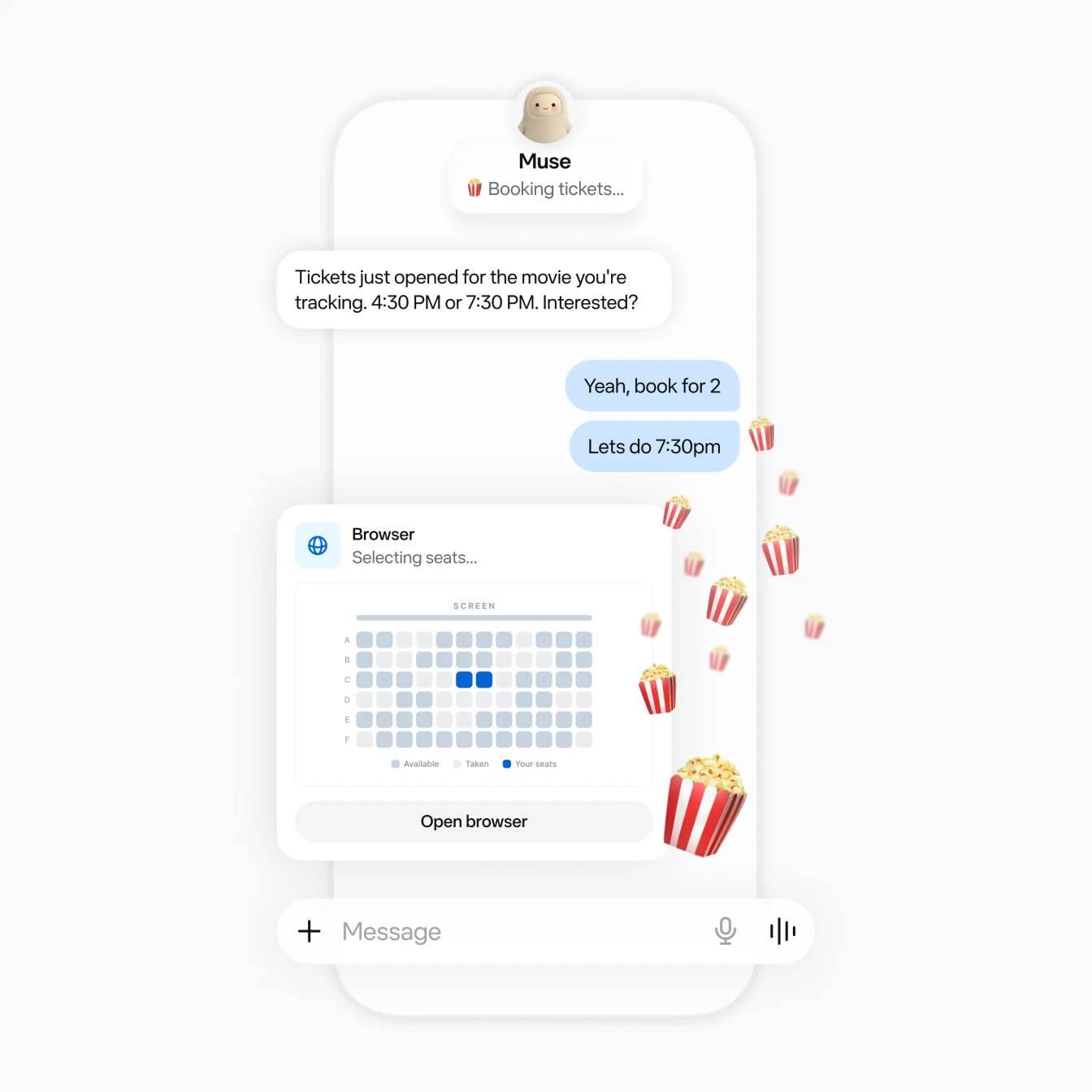
Meta’s demo: watching for movie tickets, checking with you, then choosing seats. Image: Meta.
Instinct, which was still invite-only as of September 22, is pursuing a similar idea through texts and calls. Its assistant uses connected apps and its own devices to do things like arrange an airport ride, book a handyman, or follow up on a thread you dropped. Both companies have also begun rolling out calls to businesses, including reservation requests and other errands, although access is still limited.
A startup has to earn a different kind of trust
Instinct’s founder, Noah Shinn, was an early researcher at Sierra, and the company has attracted serious funding. There’s talent and money behind it. But for an average person, it’s still a company they’ve never heard of asking to connect to their personal accounts.
Compare that with Meta. You know the company, you probably use its products, and you’ve seen it operate for years. That doesn’t mean you love or trust everything it does, but it isn’t introducing itself and asking for your inbox in the same conversation. It already has the infrastructure, distribution and money to put this in front of enormous numbers of people and keep investing in it.
Privacy still matters on both sides. Instinct allows certain user information to be used for model training unless you opt out, with exceptions and separate protections for directly connected Google Workspace data. Meta says Muse’s conversations and cloud-computer data aren’t shared with its advertising systems, and offers a training opt-out too.
If you already use Facebook, Instagram or WhatsApp, handing another job to Meta may feel like less of a leap. I get that. It doesn’t make new permissions meaningless, but familiarity and confidence that a company can support the product are real advantages. Instinct has to earn those from scratch.
Zuck might really nail hardware this time
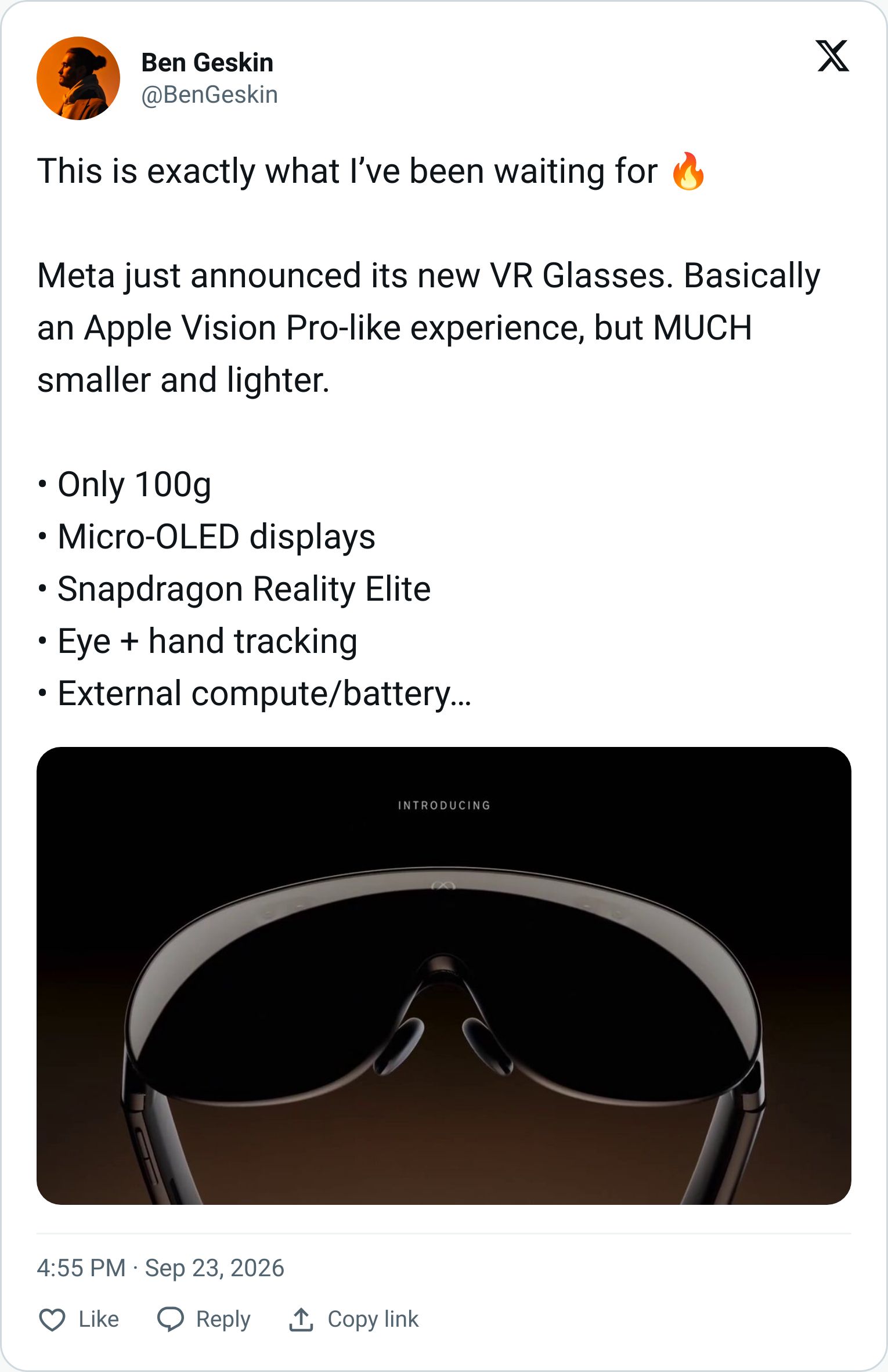
Meta’s new VR Glasses put a cinema, games or a private workspace in front of you, in something much smaller than the headsets we’re used to seeing. The glasses weigh about 100 grams on your face, with computing and battery moved into a separate, connected puck.

A private cinema is an easier idea to picture than “spatial computing.” Meta’s promotional illustration, not a photo of the view through the lenses. Image: Meta.
They have micro-OLED displays and eye, hand and voice controls. Meta plans to sell them in spring 2027 for US$1,299.99. Ben Geskin’s post gives a good look at the announcement.
A huge private screen on a flight, several screens to work across without carrying monitors, or a better way to watch a game are all things people can understand wanting. I haven’t tried these, so I can’t tell you how comfortable they’ll feel after a few hours. But making them smaller and getting the weight off your face feels like progress in the right direction.
There’s also a simpler option: Ray-Ban Meta Audio. These are separate audio-only glasses for music, calls and talking to an AI assistant, weighing 43 grams, starting at US$349, and shipping October 13. Meta is bringing Muse to its AI glasses too, so that personal assistant won’t only live in an app.
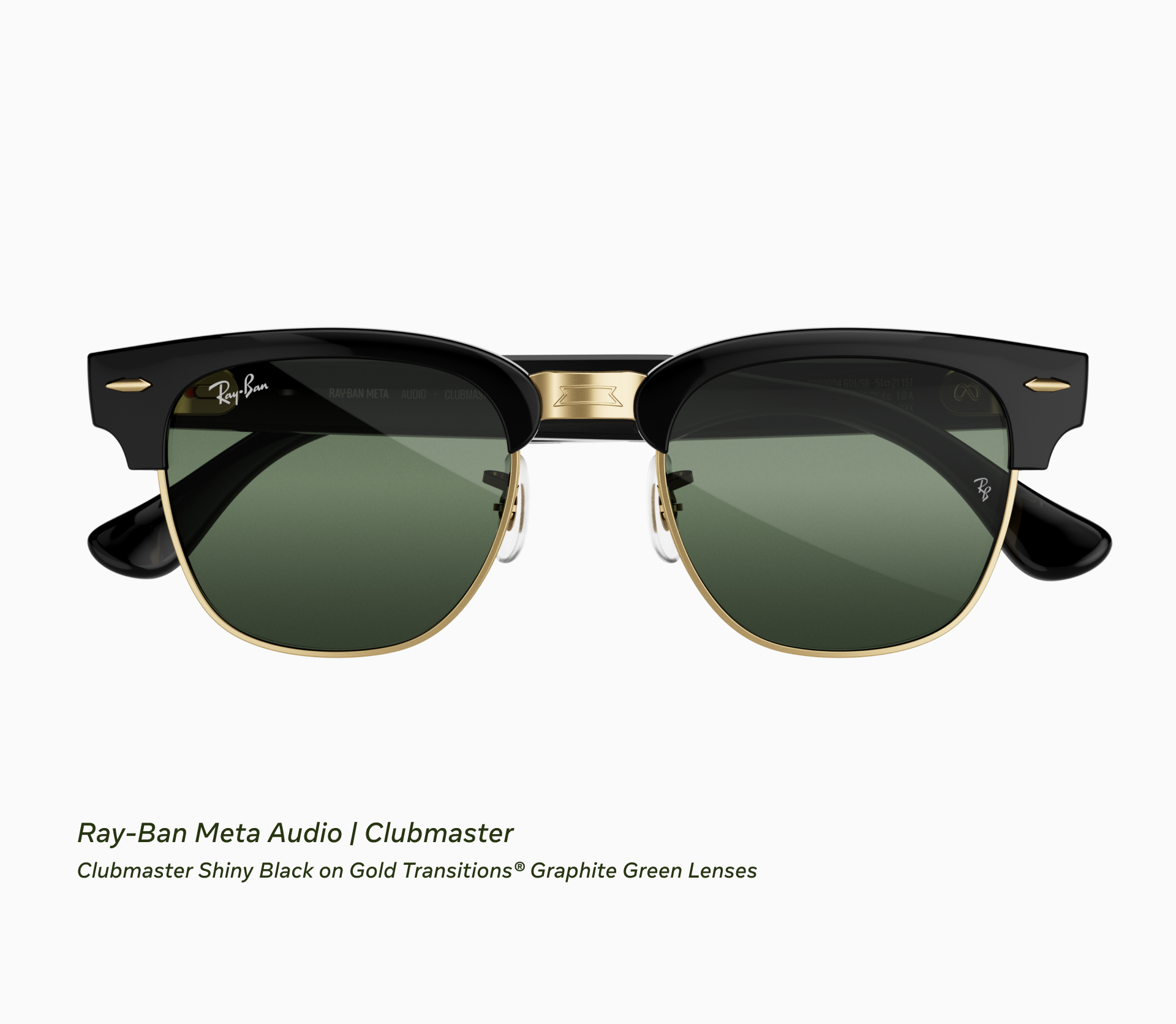
The audio-only option: Ray-Ban Meta Audio in the Clubmaster style. Image: Meta.
This is where the Steve Jobs comparison comes from for me. Beautiful hardware, less bulk, familiar controls, and a reason a normal person might want to use it. Alongside that, an assistant presented around what it can help you do, instead of asking you to become an expert in which model to pick and how long to let it think.
I’m not declaring another iPhone moment before the glasses even ship. But I like the product thinking here, and it’s making Meta a much more interesting company to watch.
The model race keeps moving
The short version of this week’s releases:
- Grok 4.7 felt like a flop to me. I tried it, and compared with what the others have delivered, it fell short. There are measurable improvements in coding and professional work, but I came away underwhelmed.
- Claude Opus 5.5 had the stronger showing. It took the top spot on that intelligence index, with particularly strong professional-work results. That isn’t a win on every task, but it’s a meaningful release, alongside lower per-token prices.
- OpenAI added more affordable choices. GPT-6 Sol and Luna sit alongside its top-tier Astra model. Independent testing found broadly similar overall intelligence to their predecessors at much lower cost, with individual gains and regressions. Developers also get more flexibility to change thinking effort and tools without losing the benefit of reusing earlier context.

What interests me is how quickly a release changes the conversation about a company. Grok makes progress, then Claude raises the bar again, while OpenAI gives people more ways to choose what fits their work and budget. A company can have a good release and still be overshadowed almost immediately.
For everyday personal use, I think Muse, Instinct and products like Grok Bot make this less important to follow. If an assistant watches your flight prices, helps organize your trip and handles the errands you give it, you shouldn’t need a hobby in model optimization. You still care whether it gets things right, what it costs, and what access you’re giving it.
For a professional or business owner using AI to do substantial work, the differences can matter much more. Better results, less correction, lower costs and the flexibility to change your setup can all affect what you’re able to do. I’ll share more about that side in future posts.
Thanks, as always, for reading.
Darwin